
Brooklyn, NY
Concrete Cutting and Removal in Brooklyn
Cellar floors, trenching, slab openings, pads, stoops, steps and yard slabs across Brooklyn. Cut to a line, broken down to what the route out can carry, and taken away.
Cutting is the easy half
A saw will cut whatever you point it at. What decides whether the job is straightforward is what happens to the material afterwards, and in a row house the answer is a narrow stair and a public sidewalk.
Concrete is heavier than anything else in a demolition scope. Once a slab is cut free it has to be lifted, carried and taken out of a building that was not designed with that in mind. So the first thing we work out is not where the cut goes. It is how the pieces leave, and how big they are allowed to be.
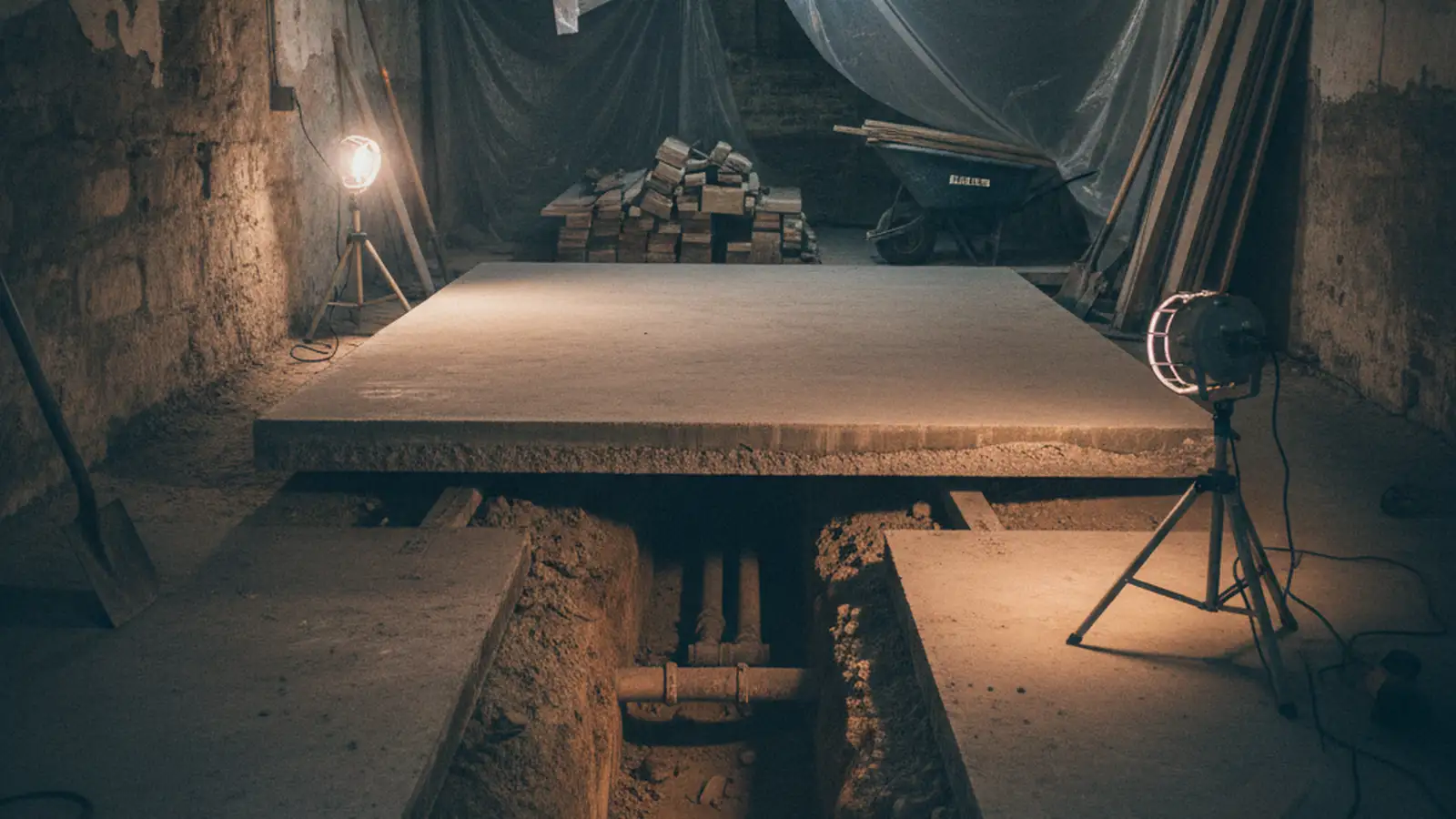
The most common concrete job in this borough is a brownstone cellar. Owners lower a cellar floor for headroom, open a trench for new drainage, or take out a slab poured over a boiler that has not been there for thirty years. All of it comes up a cellar stair or out through the garden level door, in pieces one or two people can carry, across a protected route to a container at the curb.
The work covers cellar and basement floor slabs, trenching for drainage and services, openings through slabs for stairs, shafts and risers, penetrations for the mechanical and electrical trades, machine and boiler pads, yard slabs, stoops, steps and curbs.
Where the concrete usually is
01 The cellar
Under a brownstone or a row house
Cellar slabs in an older house are frequently thin, poured over rubble rather than a prepared base, and laid around whatever was standing at the time. What is under them is rarely what a drawing says.
Everything comes up a narrow stair or out at garden level. Pieces are cut to what can be carried, the route from the cellar to the curb is protected end to end, and the noisy breaking is grouped into hours the attached neighbours have been told about.
02 The back yard
Slabs, steps and stoops
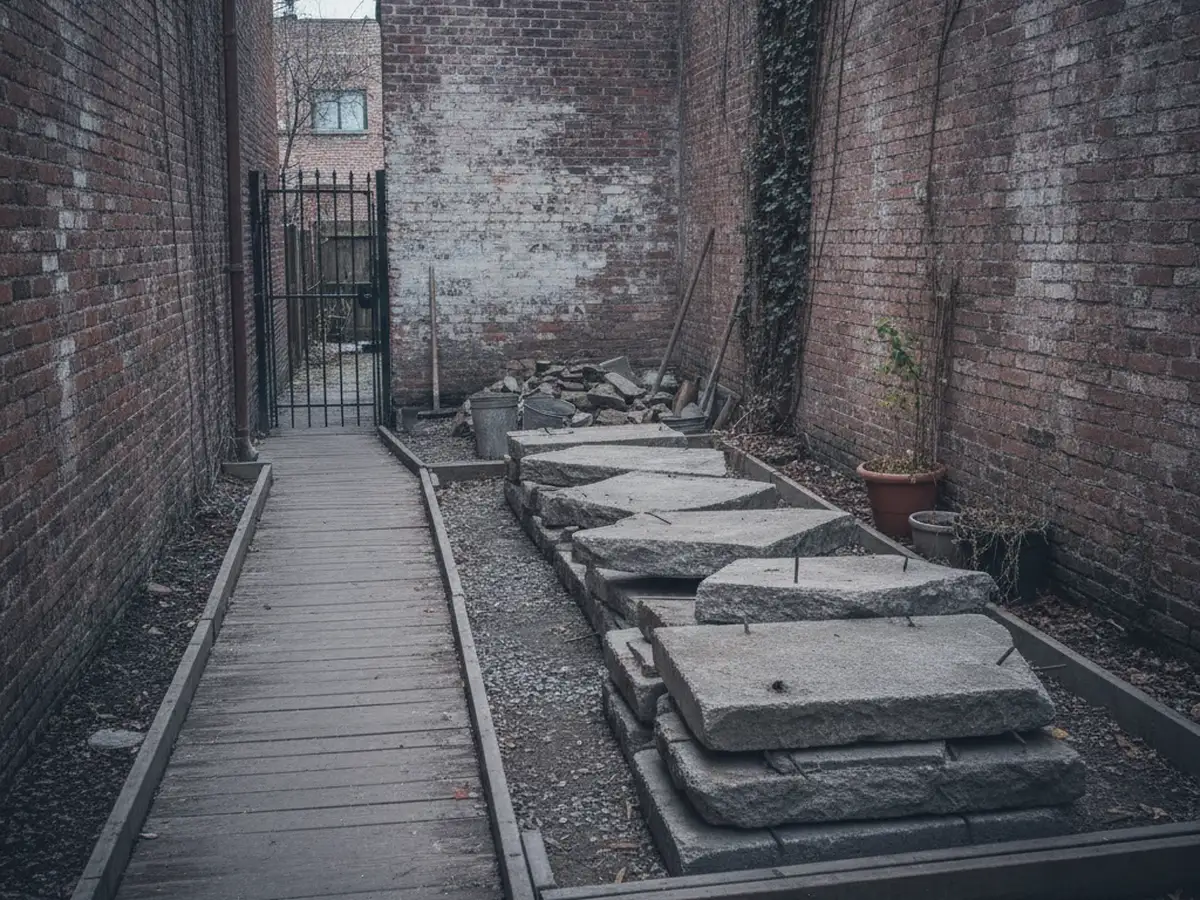
Behind a row house there is usually an old paved yard, a set of steps and a path, all of it poured decades ago. In front there may be a stoop that has been repaired more than once.
Everything still has to come through the house or through a narrow side passage, so the pieces stay small even though the work is outdoors. This is the job most often underestimated in this borough, because it looks like an easy day from the yard and is not one from the sidewalk.

03 Red Hook, Sunset Park and the conversions
Industrial floors and machine bases
Warehouse and industrial space has thick slabs, heavy machine bases and roll-up doors wide enough to work through.
Piece size stops being a constraint, plant can reach the work, and the job becomes a question of how much concrete there is. It prices completely differently from the same volume in a cellar, and it is worth saying so plainly.

A Brooklyn brownstone street
Where structure stops being ours
Cutting an opening through a floor slab removes something that was carrying load. Whether that matters, and what has to be put back, belongs to a structural engineer, not to a contractor, and it is made before anyone cuts.
On structural work a registered engineer or architect designs the opening and its support and files it with the Department of Buildings. The permit issues before the saw arrives. We execute that design and we do not stand in for the person who produced it.
There is a second reason to raise it early here. Lowering a cellar floor in a row house is not simply a thicker version of taking a slab out. Taking ground away from beside a party wall footing bears on the house next door as much as on your own, which makes it structural work rather than demolition, and structural work is designed and filed before anyone breaks anything. It is the thing owners in this borough are most often surprised to be told, and it is much better heard at the estimate.
Working inside an occupied building
Concrete work in an attached house is felt in three houses at once, so four things get managed, not tolerated.
Vibration. Breaking travels along a shared masonry party wall and into the houses either side far better than the sound does. On an attached block it is the operation that generates complaints, so it is sequenced, grouped and announced rather than started at eight in the morning.
Noise. The loudest hours are grouped into a window the neighbours know about. In a cellar under an occupied house this is usually the constraint that shapes the whole programme.
Water. Wet cutting holds the dust down and keeps the blade alive, and it makes slurry that has to be contained. In a cellar with an old floor there is nowhere for it to run to, so it is bermed and collected as it is made.
Dust. Where the cut has to be dry, extraction runs at the blade and the area stays sealed. In a house with a single stair, the route from the cellar to the front door is the thing that gets contaminated if nobody plans for it.
Common questions
Can you cut concrete inside an occupied building?
Yes. In this borough that is where most of it happens.
It changes how the work is run. It does not change whether it can happen. The area is sealed and protected, cutting is wet wherever wet cutting is possible, slurry is contained and collected as it appears, and the high-vibration operations are grouped into the hours agreed. On an attached block the houses either side are told what is happening and when, because they will feel it whether or not anyone tells them.
We agree all of that before the first cut, not after the first complaint.
How do you keep the dust down?
By not making it where that is possible, and by capturing it at the tool where it is not.
Wet cutting is the main answer, because water at the blade stops silica dust becoming airborne in the first place. Where the work has to be dry, extraction runs at the point of cut and the area is closed off with real dust separation, not a sheet taped across a door frame.
The rest is housekeeping that never stops. In a house with one stair that means the whole route from the cellar to the street stays protected for the duration, material is bagged as it is produced, and the space is cleared down at the end of every shift.